
What Is Negligence?
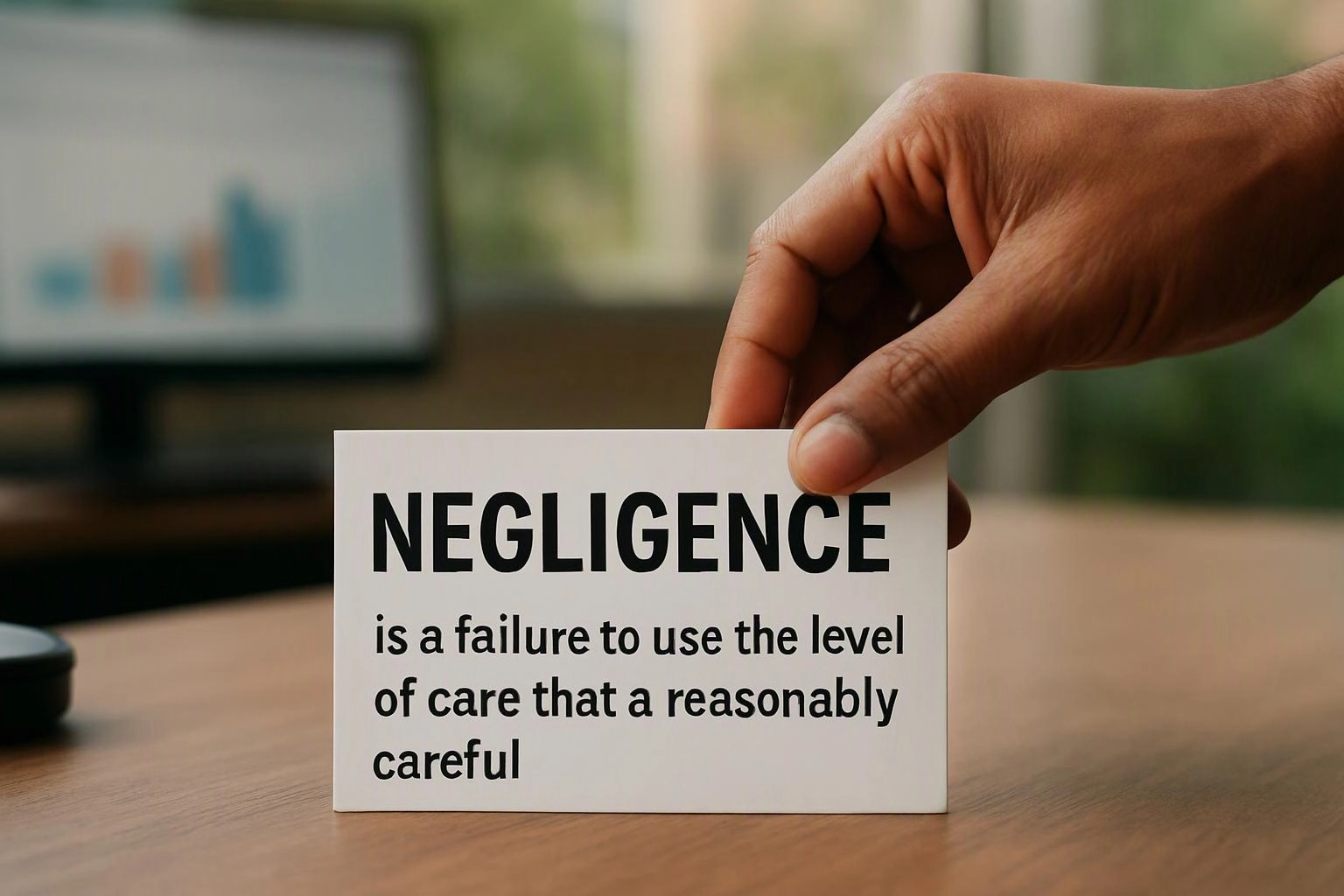
Negligence is a failure to use the level of care that a reasonably careful person would use in similar circumstances. In a car accident claim, negligence may involve unsafe driving, such as distraction, speeding, or failing to yield. The claim must connect that conduct to the collision and the resulting injury or loss.
Quick Facts About Negligence
Category
Personal injury law
Used for
Connecting careless conduct with harm
Common confusion
Negligence differs from intentional misconduct
Also called
Negligent Conduct, Careless conduct
Often discussed with
Car Accident Representation
Key Takeaways About Negligence
- Negligence focuses on unreasonable conduct under the circumstances.
- Evidence must connect the conduct to the claimed harm.
- Negligence is not the same as intentional wrongdoing.
How Negligence Works

Negligence is evaluated by examining the conduct that occurred before and during a collision. The review asks what a careful driver would have done in similar conditions. Relevant facts can include traffic movement, road conditions, witness accounts, vehicle damage, and available records.
Related glossary terms: Comparative Negligence, Gross Negligence, Proximate Cause.
A car accident claim also requires a connection between the conduct and the claimed harm. For example, a driver who looks away from traffic may fail to react in time, but the available evidence must connect that lapse to the crash. Causation addresses that connection, while damages describe the losses linked to the injury. More than one person may share responsibility when separate actions contribute to the same collision.
From the Atlanta Auto Law team
When we review negligence in a car accident matter, we organize the evidence around the driver’s conduct, the crash mechanics, and the claimed injuries. We compare statements, records, photographs, and other available evidence to test whether the conduct caused the harm. We also examine whether another person or condition contributed to the collision.
Negligence in Practice: A Real-World Example
A driver looks down at a phone while approaching a stopped vehicle and strikes it from behind. The injured driver may claim negligence if evidence connects the distraction to the collision and the resulting injuries.
Related Services
Related Terms
Comparative Negligence
Comparative Negligence is a legal rule that assigns each party a share of fault for an…
Gross Negligence
Gross Negligence is a serious failure to use even slight care in circumstances where a person…
Proximate Cause
Proximate Cause is the legal connection between a person’s conduct and an injury that makes the…
Burden of Proof
Burden of Proof is the responsibility to present enough reliable evidence to establish a claim or…
Atlanta Auto Law
Have Questions About Negligence?
Contact Atlanta Auto Law for practical guidance on Negligence and related personal injury attorney work in Atlanta.