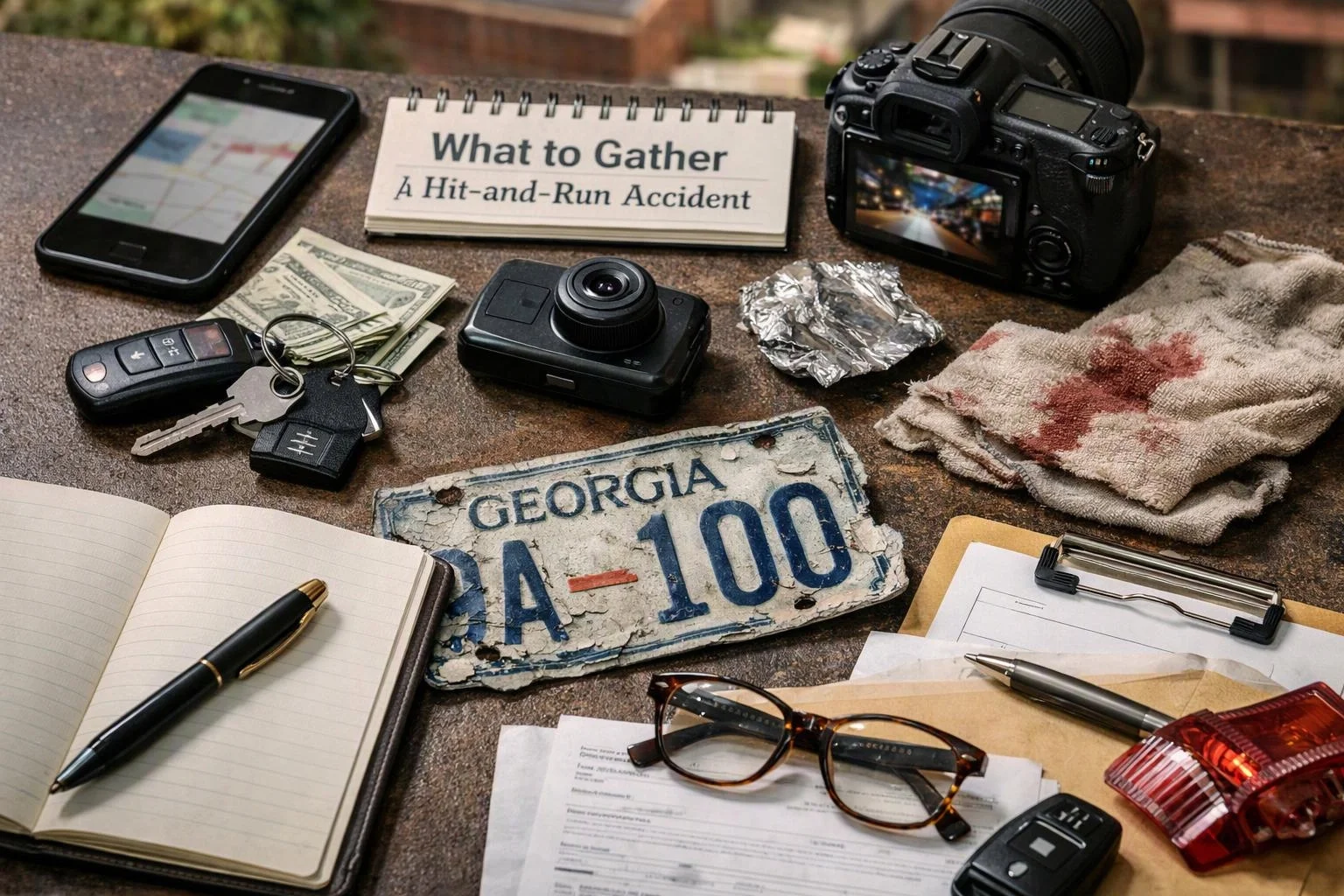
What to Gather After a Hit-and-Run Accident
What to gather after a hit-and-run accident includes scene photos, vehicle and driver details, witness contact information, surveillance leads, medical records, police reports, and insurance documents; Atlanta Auto Law uses this evidence to evaluate your representation options.
Request an EstimateWhat Information Should You Gather at the Accident Scene?
Accident scene information should document vehicle damage, road conditions, traffic controls, debris, visible injuries, and the direction of travel. Atlanta Auto Law uses these details to connect the physical scene with the hit-and-run collision.
Protect your safety first. Move away from traffic when possible and call emergency services if anyone needs immediate care.
Which Details Can Help Identify the Other Vehicle?
Vehicle identification details include the make, model, color, plate information, damage, distinctive markings, and the direction the vehicle traveled. Even a partial description can help an investigation or insurance claim.
Write down what you remember as soon as you can. Do not fill gaps with guesses, because an inaccurate detail can make later evidence harder to evaluate.
| Detail | What to record |
|---|---|
| Make and model | The vehicle brand, body style, and model if known. |
| Vehicle color | The main color, shade, and any contrasting features. |
| License plate | The full plate, a partial license plate, state information, or any letters and symbols remembered. |
| Vehicle damage | A damaged bumper, mirror, light, window, wheel, or other visible area. |
| Distinctive markings | Decals, dents, roof equipment, logos, unusual trim, or other identifying features. |
| Driver description | A description of the driver, clothing, behavior, and any statement made after the crash. |
| Direction of travel | The lane, roadway, turn, or route used by the fleeing vehicle. |
How Should You Collect Witness and Camera Information?
Witness and camera information can preserve independent evidence about the collision, the vehicle, and the driver's conduct. Ask each eyewitness for contact information and a short description of what they saw.
Record the names and locations of nearby businesses, homes, parking areas, and traffic cameras. Dashcam footage, business security cameras, doorbell cameras, and traffic cameras may show the crash or the vehicle leaving the area.
Ask the camera owner to preserve the relevant video footage. Do not edit, crop, or overwrite the original file. Our team can review the available leads and include them in the evidence preservation process.
What Official Records and Insurance Documents Should You Keep?
Official records and insurance documents should include the police report, claim communications, policy information, medical records, bills, and income-loss documentation. Keep copies of documents you send and receive during the claim investigation.
Organize the records in a way that shows what happened, when you reported it, and how the accident affected you.
What Should You Record About Your Injuries and Recovery?
Injury records should connect the hit-and-run accident with medical evaluation, treatment, symptoms, and the effect on daily activities. Seek medical evaluation when you have pain, limited movement, or other symptoms after the crash.
Keep a clear record of the treatment plan, prescriptions, follow-up appointments, and changes in your symptoms. Note how the injury affects sleep, work, household tasks, transportation, and other daily activities.
Our team uses this injury documentation with medical records and bills to understand the recovery impact and support the insurance claim.
How Does Atlanta Auto Law Review Hit-and-Run Evidence?
Hit-and-run accident representation begins with a review of the available accident evidence, insurance information, injury records, and investigation details. We organize the records so the important facts can be evaluated together.
We review the police investigation, vehicle identification clues, witness statements, surveillance footage, and claim documentation. We also examine possible insurance coverage, including uninsured motorist coverage, when the driver remains unidentified.
Our liability analysis considers how the collision occurred, what evidence supports your account, and how the available records document your losses. This review helps us assess your representation options and identify additional evidence preservation steps.
What Should You Do If You Cannot Identify the Driver?
An unidentified driver does not eliminate the need to preserve evidence or report the collision. Keep the police report, incident number, photographs, witness information, camera leads, medical documentation, and insurance records together.
Report the accident to your insurer and ask how the insurance claim will be handled under the applicable policy. Your policy may include uninsured motorist coverage that applies when the responsible driver cannot be identified.
Do not discard damaged property or delete messages, videos, or photographs connected to the crash. Atlanta Auto Law can review the available evidence, insurance information, and claim records during a legal consultation.
Questions About Gathering Hit-and-Run Evidence
What if I only remember part of the hit-and-run vehicle's license plate?
Atlanta Auto Law can use a partial license plate with the vehicle color, make, model, damage, markings, driver description, and direction of travel to evaluate the available identification evidence. Give the partial plate to the police and insurer, and write down exactly which characters you remember.
Can surveillance footage help identify a hit-and-run driver?
Yes, surveillance footage can show the collision, vehicle description, direction of travel, or driver conduct. Identify nearby traffic cameras, business security cameras, and doorbell cameras, then request preservation of the original video before it is overwritten.
What should I do if a witness leaves before I get their contact information?
Record everything you remember about the witness, including where the person stood, what the person saw, and the direction the person left. Tell the police about the witness and check whether nearby cameras captured the person or the collision.
Can I still pursue an insurance claim when the hit-and-run driver is unidentified?
Yes, an insurance claim may still be available when the hit-and-run driver is unidentified, depending on the policy and applicable uninsured motorist coverage. Preserve the police report, accident details, injury documentation, property damage records, and insurer communications for review.
Discuss Your Hit-and-Run Evidence With Atlanta Auto Law
Atlanta Auto Law reviews hit-and-run accident evidence, insurance coverage, medical records, and claim documentation to assess your representation options. Contact us to discuss the records you have preserved and the next steps for your insurance claim.