Truck Accident Evidence Mistakes That Can Hurt Your Injury Claim
Truck accident evidence mistakes can weaken an injury claim when critical records, medical proof, witness details, or crash evidence are lost or mishandled. Atlanta Auto Law helps identify missing evidence, preserve relevant records, and build claims involving traumatic brain injuries and spinal cord injuries.
Request an EstimateWhy Evidence Mistakes Can Weaken a Truck Accident Claim
Truck accident claims can weaken when important proof is lost, changed, or left with someone else. Trucking companies and insurance carriers may control records that help show driver negligence, trucking company liability, and the extent of injury damages.
Atlanta Auto Law investigates the available evidence and looks for gaps before those gaps affect the claim. We connect crash proof, medical records, and other damages evidence to the facts of the commercial vehicle collision.
Mistake 1: Leaving the Scene Without Documenting the Crash
Leaving without recording the crash scene can make vehicle damage, road conditions, traffic signs, and the position of the vehicles harder to prove. Stress, pain, safety concerns, and emergency treatment often explain why people do not take photographs or collect video evidence.
We look for other available proof, such as vehicle inspection findings, traffic-camera footage, and photographs taken by others. Prompt evidence preservation can help reduce the effect of missing crash-scene photographs.
Mistake 2: Failing to Identify Witnesses and Preserve Their Accounts
Failing to collect an eyewitness’s contact information can remove an independent account of how the collision happened. Witnesses may leave before their details are recorded, or their memories may change as time passes.
Our team gathers witness information and reviews available dashcam footage. We preserve useful witness statements in a form that supports the crash account and addresses disputed facts.
Mistake 3: Delaying Medical Care or Ignoring Symptoms
Delaying a medical evaluation can make the connection between the crash and the injury harder to establish. Delayed symptoms can occur with a traumatic brain injury or spinal cord injury, so early symptoms do not always show the full condition.
We organize medical records, imaging, bills, and treatment notes to show the symptom timeline. We also track continuity of care and the medical explanation for the claimed injuries.
Mistake 4: Posting About the Truck Crash on Social Media
Social media photographs and online statements can be taken out of context during an insurance defense review. Privacy settings do not guarantee that a post will stay private or that it cannot be requested in a claim.
We review public posts that may affect claim credibility and advise you to avoid discussing the collision, your recovery, or your activities online. Deleted content may also raise questions if its existence becomes relevant to the claim.
Mistake 5: Giving a Recorded Statement Before Reviewing the Evidence
A recorded statement to an insurance adjuster can create a fixed version of events before all evidence is available. Stress, unclear questions, and incomplete knowledge can affect the description of the collision or injury.
We review the claim statement request and the known evidence before responding. We help keep the injury description accurate and separate from assumptions made during the policy investigation.
Mistake 6: Signing a Release or Accepting Settlement Too Soon
A settlement release can end legal rights connected to the crash, even when future medical care or unknown injuries remain. A claim settlement may also fail to account for lost wages, pain and suffering, or future medical expenses.
We examine the proposed settlement agreement and the available medical proof before you decide whether to accept it. We also assess whether the release covers claims that have not fully developed.
Mistake 7: Discarding or Repairing Damaged Property Before Inspection
Discarding a damaged vehicle or repairing personal property can remove physical evidence before the parties inspect it. Repairs may also change vehicle damage that could help explain impact forces or fault.
We arrange for relevant vehicle inspection and preserve available damage evidence. We also investigate possible black box data before it is overwritten, altered, or lost.
Mistake 8: Failing to Request Trucking and Driver Records
Trucking and driver records may contain information about training, fatigue, maintenance, inspections, cargo, and compliance. Important records can include the driver qualification file, hours-of-service records, electronic logging device data, maintenance records, inspection records, and cargo records.
We send a preservation letter and pursue relevant records from the trucking company and other responsible parties. We also address possible spoliation when evidence was not preserved after the collision.
Mistake 9: Giving Inconsistent Details About the Collision or Injury
Inconsistent details about the crash account, medical history, prior injury, or symptom timeline can harm claim credibility. Differences may result from pain, stress, memory problems, or questions that were misunderstood.
We compare statements with medical records, witness information, vehicle evidence, and other documents. Our goal is to explain accurate changes without hiding relevant facts.
How Each Evidence Mistake Affects Your Claim and What to Do Next
Each evidence mistake can affect fault, causation, damages, or the reliability of the claim record. The right corrective action depends on what evidence still exists and who controls it.
We use the available record to identify the risk and choose a practical preservation request or injury documentation step.
| Evidence mistake | Why it happens | Claim impact | Corrective action |
|---|---|---|---|
| No crash documentation | Safety concerns or emergency care | Scene conditions and impact may be disputed | Locate photographs, video, and inspection evidence |
| No witness information | Witnesses leave before details are collected | Independent proof may be unavailable | Find witnesses and preserve their accounts |
| Delayed medical care | Symptoms appear mild or develop later | Causation and injury severity may be challenged | Organize treatment records and symptom history |
| Recorded statement or early release | Pressure from an insurance carrier | The claim may be limited by an incomplete record | Review communications and settlement documents |
| Missing trucking records | The trucking company controls the files | Driver negligence or company liability may be harder to prove | Send a preservation request and seek the records |
What Evidence Should You Preserve After a Truck Accident?
You should preserve crash-scene evidence, medical documentation, witness details, property evidence, financial records, and every communication about the claim. A complete record helps connect the collision to both the injury and the financial harm.
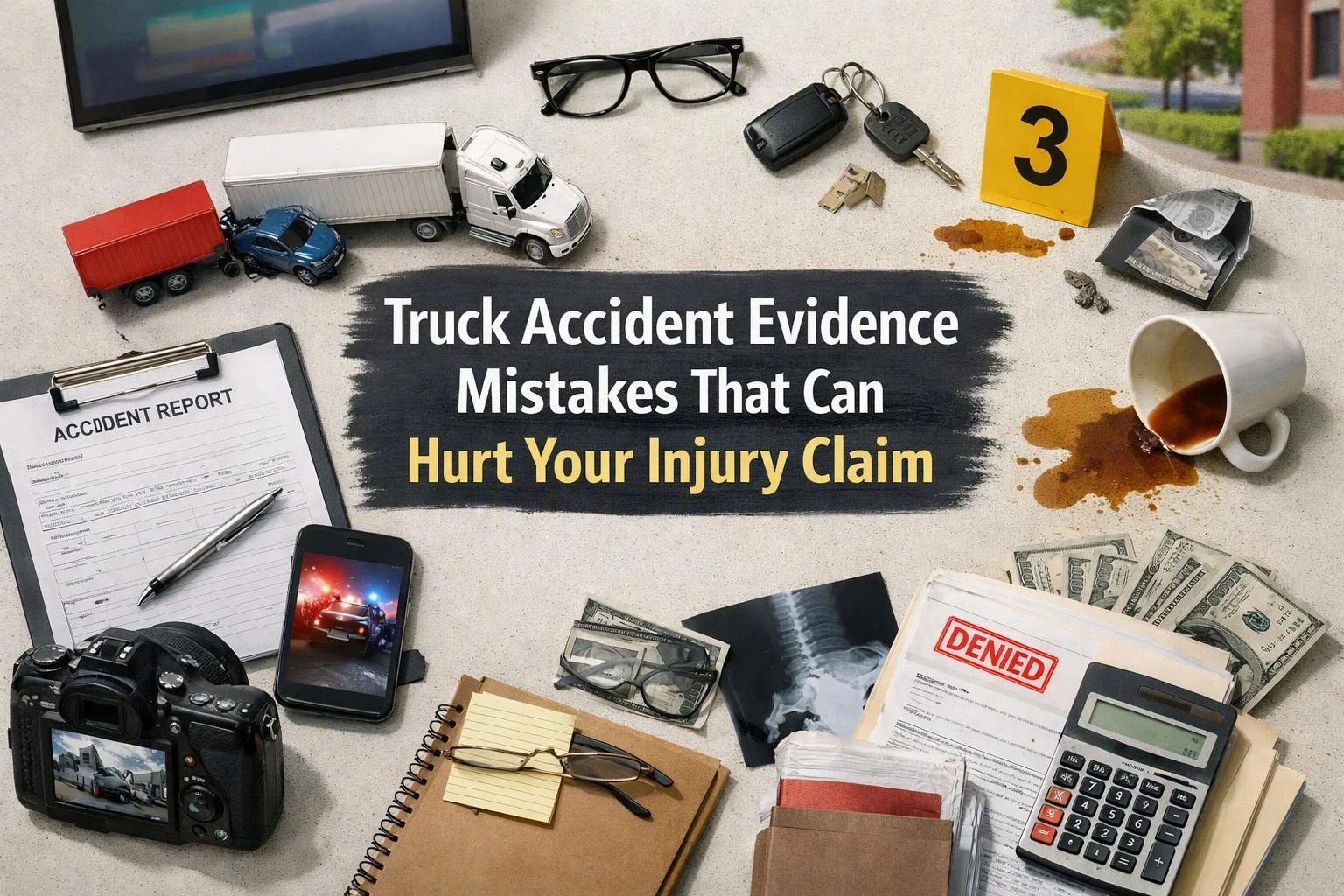
Keep original files when possible, avoid altering photographs or messages, and save copies in a secure location. Our team can organize the material and identify additional evidence to request.
When Should You Call Atlanta Auto Law About a Truck Accident Claim?
You should call Atlanta Auto Law when important evidence may be controlled by a trucking company, your injuries are serious or evolving, fault is disputed, or an insurer requests statements or documents. Early guidance can help protect evidence before records, vehicle data, or witness details become harder to obtain.
We assess the collision, the medical record, and the insurance communication before deciding what needs attention first.
How Atlanta Auto Law Helps Protect Truck Accident Evidence
Atlanta Auto Law protects truck accident evidence by investigating the collision, identifying responsible parties, pursuing relevant trucking records, organizing medical proof, and connecting the evidence to the claimed injuries.
Our team sends a preservation letter when appropriate and reviews driver qualification files, hours-of-service records, electronic logging device data, inspection records, maintenance records, and cargo records. We also work with the available accident reconstruction and medical causation evidence to present a clear injury claim.
We use the record to address fault, liability, causation, and damages. Our work can include representation for a traumatic brain injury or spinal cord injury when the evidence supports those claims.
What Should You Avoid Saying or Doing After a Truck Crash?
You should avoid making broad insurance statements, posting about the crash, signing a settlement release, or discarding evidence before the claim is reviewed. These actions can affect medical documentation, evidence preservation, and the way an insurance carrier evaluates the claim.
Give accurate information when required, but do not guess about facts you do not remember. Save communications, follow medical instructions, and contact our team before responding to a recorded statement or settlement offer.
For help with Truck Accident Representation, contact Atlanta Auto Law. We review the available evidence, explain the next steps, and help protect your legal rights.
Questions About Truck Accident Evidence Mistakes
Can deleted text messages or social media posts affect a truck accident claim?
Yes, deleted text messages or social media posts can affect a truck accident claim when they relate to the crash, injuries, activities, or communications about the claim. Atlanta Auto Law reviews the available information and helps address questions about missing or deleted content.
What happens if the trucking company has the accident evidence?
The trucking company may have control of driver records, maintenance files, electronic logging device data, vehicle information, and other evidence. We send a preservation letter when appropriate and pursue records that may show negligence, liability, or the cause of the collision.
Can a truck accident claim continue if I did not take photographs at the scene?
Yes, a truck accident claim can continue without photographs taken by you. Other evidence may include photographs from witnesses, video, vehicle inspection findings, medical records, witness statements, and trucking company records.
Why do insurers ask for medical records after a truck accident?
Insurers ask for medical records to evaluate the claimed injuries, treatment, causation, prior conditions, and expected care. We review requests carefully so the medical proof addresses the claim without unnecessary disclosure.
Can prior injuries affect a new truck accident injury claim?
Yes, prior injuries can affect how a new truck accident injury claim is evaluated, but they do not automatically prevent recovery. We compare the prior medical history with the new symptoms, treatment, and medical opinions to address the effect of the collision.
Related Resources
Benefits of Hiring a Personal Injury Attorney for a Serious Injury
Compared ToIn-House vs Specialist Personal Injury Attorney: Cost, Accuracy & Compliance Compared
Everything About ItPreparing Traumatic Brain, Spinal Cord, Burn, and Amputation Injury Claims
Everything About ItPreparing a Truck Accident Case and Understanding Liability